
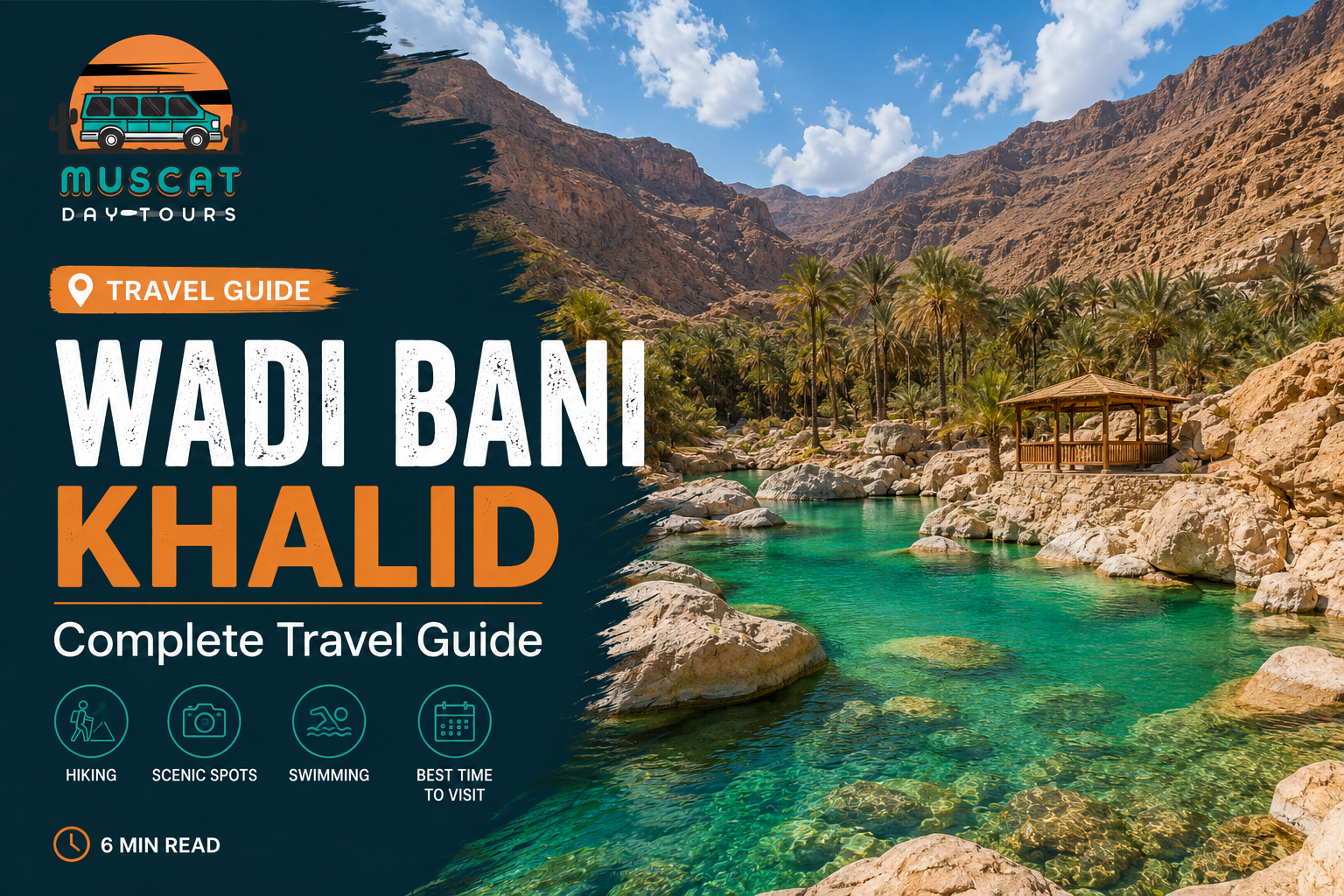
There’s a moment on the drive out from Muscat when the highway suddenly gives way to a crack in the mountains, and you catch your first glimpse of turquoise water sitting in the middle of brown desert rock. That’s Wadi Bani Khalid, and it’s the reason so many first-time visitors to Oman end up planning their whole itinerary around a single day trip.
This Wadi Bani Khalid travel guide covers everything you need before you go: how far it is from Muscat, how to get there, what it actually costs, when to visit, what to pack, and the mistakes that catch out most first-timers. Whether you’re road-tripping from the capital or combining it with a desert camp in Wahiba Sands, this guide is built to answer the questions people actually search for before booking.
Wadi Bani Khalid matters because it’s one of the only wadis in Oman that holds water all year, even in the peak of summer, which makes it a rare and reliable stop on any Oman itinerary.
Quick Answer: Is Wadi Bani Khalid Worth Visiting?
Yes. Wadi Bani Khalid is one of Oman’s most accessible and family-friendly wadis, located in the Al Sharqiyah region roughly 200–235 km (about 2.5 to 3 hours by car) east of Muscat. Unlike most wadis in the country, its emerald pools flow year-round, so there’s no risk of arriving at a dry riverbed.
The site has two distinct sides. The northern section is developed for tourism, with a footbridge, seating areas, and a small restaurant overlooking the main pool. This part suits almost anyone, including older travelers and young kids. The southern side, sometimes called Wadi Hayer, is rockier and better suited to hikers who want a proper scramble.
Most visitors spend two to four hours here: swimming in the main pool, walking the short canyon trail, and exploring Muqal Cave near the end of the path. It pairs naturally with a Wahiba Sands desert camp or a stop in Sur, since both are within a similar driving radius. If you only have one day near the eastern coast of Oman and want water, shade, and a bit of adventure without a serious hike, Wadi Bani Khalid delivers all three.
Where Is Wadi Bani Khalid and How Far Is It From Muscat?
Wadi Bani Khalid sits in Oman’s Al Sharqiyah North region, on the eastern side of the Hajar Mountains. It’s roughly 200–235 km from Muscat, and driving estimates typically run between 2.5 and 3 hours, depending on which route and starting point you use. If you’re coming from Sur instead, it’s a shorter trip — around 120 km, or roughly 1 hour 45 minutes.
For travelers heading to or from Wahiba Sands, the wadi is conveniently close to Bidiyah, the town most desert camps use as their gateway. That stretch is about 46 km, or under an hour by car.
Quick fact: Wadi Bani Khalid is one of the few wadis in Oman with a constant, year-round water flow, which is why it stays green and swimmable even during the dry summer months when many other wadis reduce to a trickle or dry out completely.
Semantic context: what “wadi” actually means.
A wadi is the Arabic word for a valley, and in Oman it specifically refers to a rocky river gorge that fills with water, forming natural swimming pools between canyon walls. Some wadis in Oman only flow after rain. Wadi Bani Khalid is different; its pools are fed by underground springs, which is the main reason it holds water consistently.
How to Get to Wadi Bani Khalid
There are three practical ways to reach Wadi Bani Khalid, and your choice mostly comes down to budget, flexibility, and whether you’re combining the trip with a desert stay.
Option 1: Self-drive (most common)
From Muscat, you’ll take Route 23 (the Muscat–Sur road) heading southeast. Near the district of Al Wasil or Al Kamil, a signposted secondary road branches off toward the wadi. The turning is well marked, so it’s hard to miss even without local knowledge. The road is paved the entire way, and a standard sedan handles it fine; you don’t need a 4×4 for this trip specifically.
Step-by-step directions:
- Leave Muscat via Route 23 toward Sur.
- Continue for roughly 2 to 2.5 hours until you reach the Al Wasil / Al Kamil area.
- Watch for the signposted turnoff toward Wadi Bani Khalid.
- Follow the secondary road for about 30–40 minutes through farmland and small villages.
- Park at the main car park near the entrance — this is where the walk to the first pool begins.
Option 2: Taxi or private driver
If you’d rather not drive, hiring a taxi or private driver for the day is common among tourists staying in Muscat. This costs more than self-driving but removes the stress of navigation and gives you a driver who can wait while you swim and explore.
Option 3: Bus plus local transport
Public buses run from Muscat toward the eastern region, cutting the trip down to roughly two hours, after which you’ll need a taxi or arranged local transport to cover the final stretch to the wadi entrance. This is the most budget-friendly option but takes more planning, since onward transport from the drop-off point isn’t always guaranteed on short notice.
Comparison Table: Getting to Wadi Bani Khalid
| Method | Approx. Time from Muscat | Flexibility | Best For |
| Self-drive (rental car) | 2.5–3 hours | High | Independent travelers, families |
| Private taxi/driver | 2.5–3 hours | Medium-High | Visitors who don’t want to drive |
| Bus + local transport | ~2 hours + connection | Low | Budget travelers with flexible time |
What to Expect: The Two Sides of the Wadi
Wadi Bani Khalid is really two experiences in one location.
The northern (leisure) section is what most photos and reviews show: a large emerald pool crossed by a footbridge, shaded seating areas, a restaurant, and gentle rock faces perfect for a picnic. The walk from the car park to this first pool takes just a few minutes across flat rocks and a falaj, an ancient Omani water channel still used for irrigation today. This area works well for children, older travelers, and anyone who wants swimming and scenery without a real hike.
The southern section, sometimes referred to as Wadi Hayer, is rockier and more rugged, better suited to visitors who want proper trekking or bouldering. If you’re short on time, the northern section alone is enough for a satisfying visit, but if you have half a day, pushing into the southern trail rewards you with quieter pools and fewer crowds.
Things to do at Wadi Bani Khalid
- Swim in the main pool (and the smaller pool just beyond it, reachable by a short swim across)
- Walk the canyon trail toward Muqal Cave
- Slide down the smooth natural rock slides formed by water erosion
- Eat at the restaurant overlooking the bridge
- Photograph the palm groves and cliff backdrops
- Hike the rockier southern trail (Wadi Hayer) for a quieter, more physical route
Muqal Cave: What’s Inside and Is It Worth It?
At the end of the canyon trail, roughly 1 km past the first pool, sits Muqal Cave (also spelled Kahf Maqal, Moqal Cave, or Miqil Cave). This is one of over 3,000 documented caves in Oman, carved into limestone rock that geologists estimate is around 220 million years old.
Inside, you’ll find low, narrow passages, small underground pools, and a resident colony of bats. There are no dramatic stalactites or stalagmites here; it’s a simpler cave than that, but the atmosphere alone makes it worth the short detour. The cave runs roughly 50 meters deep, ending in a sump pool, so it’s not a long exploration, but it does require caution.
Practical notes for visiting Muqal Cave:
- Bring a torch or use your phone’s flashlight; it gets dark fast just a few steps in.
- Wear shoes you don’t mind getting wet or dirty; the ground is uneven and often damp.
- Expect a couple of shallow stream crossings on the way, usually with low water levels in normal conditions.
- Tight spaces mean this isn’t ideal for anyone with claustrophobia.
- Take it slowly; the rocks near the entrance can be slippery.
Best Time to Visit Wadi Bani Khalid
Direct answer: The best time to visit Wadi Bani Khalid is between October and April, when daytime temperatures are milder, and early morning on a weekday, when crowds are thinnest.
Seasonal breakdown
October to April (cooler season): This is the most comfortable stretch for hiking the canyon trail and reaching the cave without overheating. Daytime temperatures are noticeably more manageable than in summer, and the water stays refreshingly cool.
May to September (hot season): Wadi Bani Khalid is still open and still swimmable, since the pools flow year-round, but midday heat in the Al Sharqiyah region can be intense. If you visit in summer, plan to arrive early in the morning and stay near the water rather than hiking exposed rock in peak heat.
Time of day and day of week
Weekends, especially Fridays, are the busiest, since Wadi Bani Khalid is a popular local picnic spot for Omani families as much as it is a tourist destination. Arriving early on a weekday morning is your best shot at a quieter pool and easier parking.
Entry Fees, Facilities, and Practical Costs
Reported entry costs for Wadi Bani Khalid vary by source, with some describing it as free to enter and others mentioning a small parking or facility charge. Confirm current pricing locally before you go, since fees at natural attractions in Oman can change without much notice online.
What you can count on:
- A car park at the entrance (bring small cash in Omani rials in case of a parking fee)
- A restaurant near the main bridge serving local Omani food and drinks
- Shaded seating areas near the first pool
- Basic facilities, though don’t expect resort-level infrastructure once you move beyond the main pool area
Nearby eateries
Local food stalls and the on-site restaurant offer Omani cuisine, so you don’t need to pack a full meal, though snacks and water for the trail are still worth carrying.
What to Pack and Wear
- Sturdy, grippy shoes; flip-flops don’t hold up on wet rock, and the canyon path has uneven, slippery sections
- Swimwear worn modestly under regular clothes, in line with local customs
- A change of clothes for the drive back
- A torch or phone flashlight if you plan to enter Muqal Cave
- Reusable water bottle and snacks, especially in the hot season
- Sun protection: sunscreen, a hat, and sunglasses
- Small cash (Omani rials) for parking or the restaurant
- A dry bag for phones and cameras if you’re swimming with electronics
Safety: Flash Floods and Swimming Conditions
This is the section most travel blogs underplay, so it deserves direct attention.
Wadis in Oman, including Wadi Bani Khalid, are prone to flash flooding after heavy rain in the surrounding mountains, even if it isn’t raining where you’re standing. A significant flood hit the wadi in May 2019, and another flood in 2024 altered parts of the walking path near the car park. This isn’t a rare, one-off event; it’s a known seasonal risk.
Core safety rules:
- Never camp inside the wadi itself; water levels can rise suddenly and without warning.
- Check the weather forecast for the wider mountain region, not just the wadi’s immediate location, before you go.
- If rain is forecast or has recently fallen upstream, postpone your visit.
- Follow all posted signage and any instructions from site staff or local authorities.
- Deeper sections of the pools can be genuinely deep a buoyancy aid is a smart addition if you’re not a strong swimmer.
- Avoid jumping from cliffs or rocks; injuries here are common and largely avoidable.
Swimming itself is not mandatory to enjoy the site; you can walk the trail, view the pools, and visit the cave entrance without getting in the water if you’d rather stay dry.
Where to Stay Nearby
Accommodation directly next to Wadi Bani Khalid is limited, since the surrounding area is mostly farmland and small villages. Most visitors choose one of these instead:
- A desert camp in Wahiba Sands, roughly 45 minutes to an hour away, which pairs naturally with a wadi visit
- A guesthouse or hotel in Sur, about 1 hour 45 minutes away, ideal if you’re continuing along the coast toward the turtle reserve
- A rest house closer to the wadi itself, useful if you want an early start the next morning without a long drive
Expert Tips Box
From experienced Oman travelers:
- Arrive before 9 a.m. on a weekday for the quietest experience and easiest parking.
- The first pool near the bridge is enough for most casual visitors; you don’t have to hike all the way to the cave to have a great visit.
- Bring a padlock and a bag you can carry while swimming; there’s no formal locker system at the entrance.
- Local kids sometimes offer to carry bags to the picnic area for a small tip; this is optional, not required.
- If the water looks murky, it may be recent flash-flood runoff rather than poor water quality; ask locally if you’re unsure.
Common Mistakes to Avoid
- Visiting right after rain in the mountains. Even clear skies at the wadi don’t mean it’s safe — flash floods can originate far upstream.
- Wearing flip-flops on the canyon trail. The rocks get slippery fast, especially near the cave.
- Assuming a 4×4 is required. The road to the main site is paved; a regular car is fine for the standard route.
- Underestimating the drive time. Google Maps estimates can run optimistic — budget the full 2.5 to 3 hours from Muscat, plus stops.
- Camping in the wadi. This is a genuine safety risk, not just a rule for its own sake.
- Skipping cash. Card payment isn’t reliably available at every stall or parking point.
- Going only on weekends. If crowds bother you, a weekday visit makes a real difference.
Pro Tips
- Pack a dry bag. Phones and cameras are easy to damage near the pools.
- Time your cave visit for cooler hours; mornings are more comfortable for the short, tight walk inside Muqal Cave.
- Ask locally about recent flood activity before swimming deeper into the canyon; conditions can shift after storms.
- Bring small-denomination rials for parking, snacks, and optional tips.
- Combine with Wahiba Sands if you want to turn a day trip into an overnight adventure without much extra driving.