
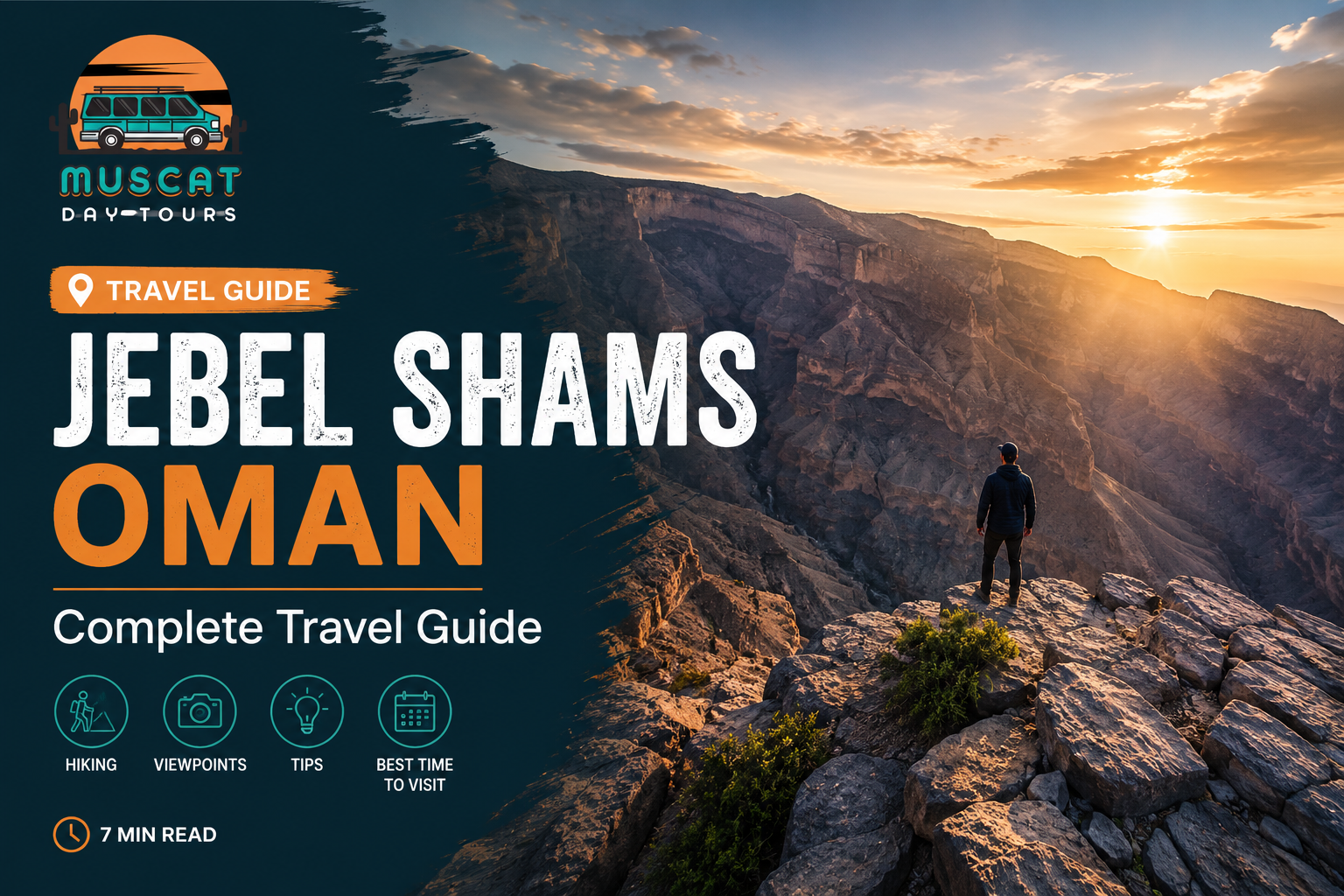
There’s a moment on the drive up to Jebel Shams when the road stops feeling like it’s taking you into the mountains and starts feeling like it’s taking you above everything else. The heat of the coast falls away, the vegetation thins out, and somewhere past Nizwa, the landscape turns into bare rock and long views. By the time you reach the rim, you’re standing at 3,009 meters, the highest point in Oman, looking down into a canyon so deep and so sudden that “Grand Canyon of Arabia” stops sounding like a tourism slogan and starts sounding like an understatement.
This guide covers what you actually need to know before going: how to get there, what the Balcony Walk is really like, when to visit, where to camp, and the small details, like a jacket, a full tank of fuel, and a decent pair of shoes that make the difference between a trip that goes smoothly and one that doesn’t.
Where Is Jebel Shams, Exactly?
Jebel Shams sits in the Al Hajar Mountains, within Ad Dakhiliyah Governorate, roughly 240 kilometers from Muscat, about three to three and a half hours by car. The name translates to “Mountain of the Sun,” and locally, the canyon beneath it is known simply as Wadi Ghul, though most visitors know it by its nickname: Oman’s Grand Canyon.
The mountain is also referred to as Jebel Shams Mountain or, in Arabic, جبل شمس. If you’re researching the area online, you’ll see the spelling varies between “Jebel” and “Jabal”; both refer to the same place, and both are common enough in English-language sources that it’s worth searching both if you’re digging for trip reports or route details.
Getting There From Muscat
The drive from Muscat takes you through Nizwa, Oman’s old interior capital, before climbing into the mountain roads that lead up to Jebel Shams. The route is well-traveled and manageable in a standard sedan as far as the main viewpoints and the start of the Balcony Walk. It’s only the final stretch toward the true summit tracks where the road turns rough enough that a 4WD becomes the sensible choice rather than an optional upgrade.
A few practical notes for the drive:
- Fuel up in Nizwa or Al Hamra before heading up. Options thin out fast once you’re on the mountain.
- Phone signals become unreliable in patches along the upper road. Download offline maps before you leave the coast.
- If you’re driving yourself, don’t rush the descent. The road down has the same drop-offs as the road up, and there’s no advantage to doing it in the dark.
Many visitors combine the drive with a stop in Nizwa itself, or extend the trip into a two-day loop through Misfat al Abriyeen and Al Hamra, both known for old mudbrick villages and terraced palm groves that make a good contrast to the bare rock higher up.
The Balcony Walk: What It’s Actually Like
The Balcony Walk is the single most-searched reason people come to Jebel Shams, and it earns their attention. It’s a cliffside trail that traces the canyon rim, passing directly beside an abandoned mountain village of stone houses with no roofs left, built into ledges that make you wonder how anyone lived there day to day. The trail itself has stretches where the path narrows to a meter or less with a genuine drop on one side, which is exactly why it has the reputation it does.
In terms of difficulty, it’s classified as a moderate hike rather than a technical one. There’s no climbing gear involved, no ropes, no scrambling that requires real technique. What it does require is sturdy footwear, a reasonable level of fitness, and comfort with heights; the exposure is the main challenge, not the terrain itself. Most travelers with average fitness complete it without serious difficulty, but this isn’t the trail to attempt in flip-flops or with young children who tend to wander.
Morning is the best time to start. The light is better for photos, the temperature is more forgiving, and you’ll likely have more of the trail to yourself before later arrivals show up.
Beyond the Balcony Walk: Summit and Canyon Views
Not everyone comes for the hike. The summit and the surrounding viewpoints are worth the trip on their own, particularly if you’re short on time or traveling with people who aren’t up for a cliffside trail. Several viewpoints are accessible by sedan, offering the same dramatic canyon views without the walking.
The true summit tracks are a different story: rougher, less maintained, and genuinely better suited to a 4WD with some ground clearance. If seeing the highest point in Oman is the goal rather than the hike itself, it’s worth arranging a vehicle that can handle the terrain rather than testing the limits of a rental sedan.
Camping on the Rim
This is where Jebel Shams quietly becomes one of the best things to do in Oman that doesn’t get talked about enough. Camping on or near the canyon rim means waking up to a sunrise that most day-trippers never see and a night sky that’s genuinely dark. There’s almost no light pollution up here, which makes it one of the better stargazing spots in the country.
The catch is temperature. Daytime warmth at the base of the mountain does nothing to prepare you for how cold it gets after sunset at this altitude. Even in the warmer months, nights can drop sharply once the sun is behind the ridge. Bring real layers, not a light jacket you’re hoping will be enough. A few facilities exist nearer the main viewpoints: mountain resorts, established campsites, and local guesthouses for anyone who’d rather not camp fully off-grid.
Best Time to Visit
November through February is peak season at Jebel Shams, and for good reason. Daytime temperatures typically sit between 5°C and 20°C, which is cold enough that campers need proper layers at night but comfortable enough during the day for hiking without the heat working against you.
From March through October, the mountain stays noticeably cooler than Muscat’s coastal humidity, even as summer afternoons climb higher — sometimes into the high 20s or low 30s. If your goal is escaping the coastal heat rather than chasing the coldest nights, the shoulder months can still work well; just pack for a wider temperature swing across a single day.
If you’re planning around comfort specifically, winter is the safer bet. If you’re planning around avoiding crowds, the shoulder season is worth considering, with the understanding that afternoons will run warmer.
What to Pack
A few items make a disproportionate difference on this trip:
- A warm jacket. Not optional, even outside peak winter. Temperatures drop fast once the sun sets.
- Proper hiking shoes. The Balcony Walk and most viewpoint trails involve uneven, rocky ground.
- More water than feels necessary. There’s limited access to shops or refill points once you’re past the main settlements.
- Camping gear, if you’re staying overnight — sleeping bags rated for cold nights, not summer-weight ones.
- A camera, ideally with a wide lens. Sunrise over the canyon is the shot that ends up in everyone’s trip photos, and phone cameras tend to underdeliver on the scale of it.
- Snacks and supplies. Facilities thin out considerably near the summit and along the more remote trail sections.
Wildlife and the Mountain Ecosystem
Jebel Shams isn’t just a viewpoint; it supports a small but distinct mountain ecosystem that’s worth paying attention to as you hike. Mountain goats are a regular sight along the cliff faces, moving across terrain that looks nearly vertical from below. Golden eagles are often visible riding thermals above the valley, especially in the early morning when the air is still cool. Ancient juniper trees cling to the cooler slopes nearer the summit, some of them notably old given the harsh growing conditions. And after dark, the same lack of light pollution that makes for good stargazing also means the mountain feels considerably quieter and wilder than anywhere along the coast.
Practical Tips From Experience
Start early. Morning light is better for photography, temperatures are more comfortable for hiking, and you’ll beat the bulk of day-trip traffic coming up from Muscat.
Don’t underestimate the cold. This is the single most common mistake visitors make. Oman’s coastal heat creates an expectation that doesn’t hold up at 3,000 meters, particularly after dark.
Wear real shoes. The rocky, uneven terrain around the Balcony Walk and most viewpoints isn’t forgiving of sandals or worn-out soles.
Carry your own supplies. Shops and facilities are limited once you’re past the main access points, especially near the summit tracks.
Consider a guide for the more involved routes. It’s not strictly required for the main viewpoints, but a local guide adds real value for the Balcony Walk, off-road driving, or deeper canyon exploration — partly for safety, partly because they tend to know which detours are actually worth taking.
Is Jebel Shams Safe?
For the overwhelming majority of visitors, yes. The risks that do exist are largely self-inflicted: getting too close to unmarked cliff edges for a photo, or attempting the Balcony Walk during heavy rain or fog when visibility and footing both suffer. Stick to marked trails, respect the edges, and check conditions before setting out; Jebel Shams is a manageable trip for most reasonably fit travelers.
Day Trip or Overnight? How to Decide
Jebel Shams works both ways, and which one suits you depends on what you’re actually after.
A day trip from Muscat is realistic if you leave early — ideally before 7 a.m. — and are comfortable with a long drive on both ends. You’ll have time for one of the main viewpoints and a partial or full Balcony Walk, but you’ll be doing the return drive after a full day of hiking in the sun, which is worth factoring in before committing to it. This option suits travelers on a tight schedule or those combining Jebel Shams with other stops in a single-day loop.
An overnight trip is the better choice if the Balcony Walk, the summit, and a proper look at the canyon are all on your list, or if camping under a dark sky is part of the appeal. Splitting the drive across two days also means you’re not hiking on tired legs after three-plus hours behind the wheel, and it opens up an early sunrise over the canyon that a same-day visitor simply won’t see. Many travelers extend this into a two-day loop that folds in Nizwa, Misfat al Abriyeen, or Al Hamra, turning the mountain into one stop in a broader interior itinerary rather than an isolated trip.
If you’re unsure, the overnight option is generally worth the extra planning. The difference between a rushed afternoon at a viewpoint and a full morning on the rim is significant, and it’s the kind of trip that’s harder to redo than to simply extend by a day the first time around.
Where to Stay
Accommodation near Jebel Shams ranges from mountain resorts with proper rooms and views over the canyon, to simple established campsites for anyone bringing their own gear, to smaller local guesthouses run by families in the surrounding villages. None of these compete with Muscat’s hotel scene in scale, and that’s largely the point; the appeal here is proximity to the rim and quiet, not amenities. Booking ahead is worth doing during peak season, particularly around weekends, since options thin out fast the closer you get to the main viewpoints.
Frequently Asked Questions
How far is Jebel Shams from Muscat?
Approximately 240 kilometers, which typically takes three to three and a half hours by car, routing through Nizwa.
Is the Balcony Walk difficult?
It’s a moderate hike with uneven, rocky terrain and sections of real exposure near the cliff edge, but no technical climbing is involved. Most travelers with average fitness manage it comfortably.
Do I need a 4WD to visit Jebel Shams?
Not for the main viewpoints or the Balcony Walk trailhead a standard sedan handles that route fine. A 4WD is recommended for reaching the true summit tracks, where the road becomes rougher.
Does it snow at Jebel Shams?
Occasionally, near the summit, during the coldest weeks of winter. It’s not frequent enough to plan a trip around, but it does happen most years.
Conclusion
Jebel Shams rewards people who treat it as more than a photo stop on the way to somewhere else. The Balcony Walk alone justifies the drive, but the mountain’s real appeal is in the details most day-trippers miss: a night camped on the rim under genuinely dark skies, an early sunrise over the canyon before anyone else arrives, the sudden cold that catches people off guard if they didn’t pack for it. Give it more than a rushed afternoon if you can. Bring warm layers regardless of the season, wear shoes built for rocky terrain, and leave enough time to actually sit at the edge of Oman’s Grand Canyon instead of just photographing it and moving on.